
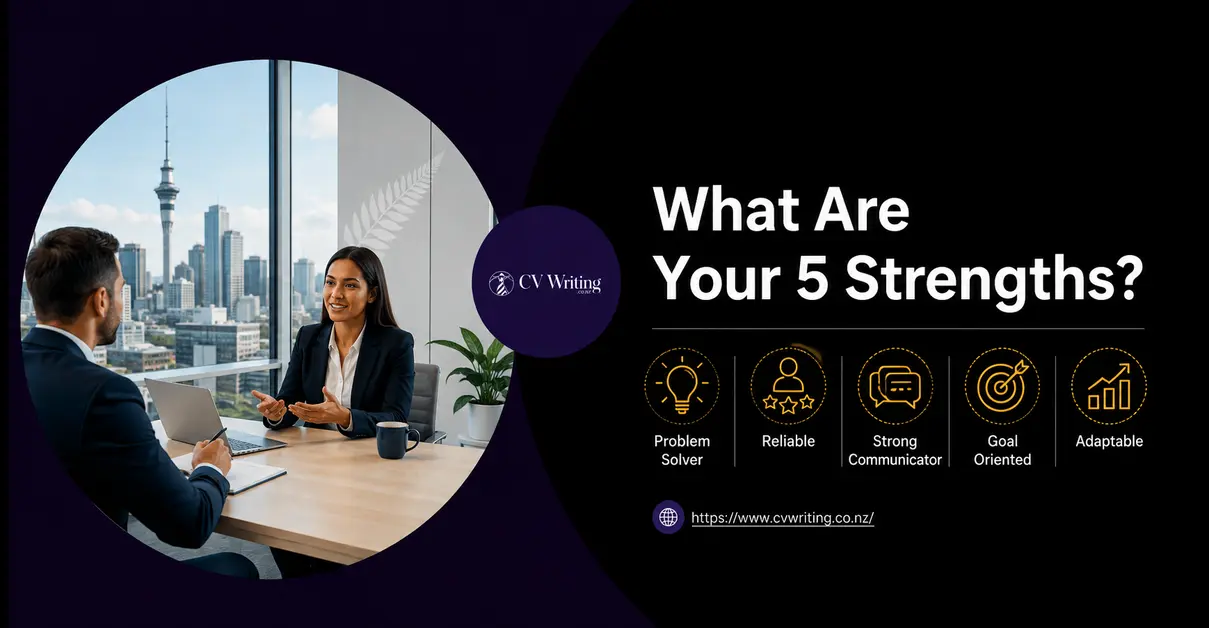
What Are Your 5 Strengths?
“What are your 5 strengths?” is a common interview question, but a good answer requires more than listing five positive qualities. Employers want to understand how your strengths affect the way you work, contribute to a team and handle responsibilities.
The strongest answers connect each strength to a real example rather than simply saying, “I am hardworking” or “I am a good communicator”.
You may also be asked about your weaknesses during the same interview. Preparing for both questions can help you give honest answers without unnecessarily highlighting areas that could damage your suitability for the role.
How To Tell Your Strengths To The Hiring Manager?
Here is everything you need to know to avoid chances of getting confused and stay well-prepared for the question related to strength & weakness in interview.
What Does the Interviewer Want to Know?
When an interviewer asks about your strengths, they are usually trying to understand whether your skills match the position.
For example, a customer service role may require patience and communication, while a project management position could place greater emphasis on organisation, decision-making and leadership.
Your answer should therefore be connected to the job.
Before the interview, read the job description carefully and identify the qualities the employer appears to value. You can then select strengths that are genuinely relevant to the position.
Why Is “What Are Your 5 Strengths?” Important in an Interview?
This question gives employers an opportunity to see how well a candidate understands their own abilities. It also helps them compare the qualities mentioned by the candidate with the requirements of the role.
A strong answer can help an interviewer:
- Understand which skills you rely on in the workplace.
- See whether your strengths match the job requirements.
- Learn how you have used particular skills in real situations.
- Assess your level of self-awareness.
- Identify qualities that could benefit the wider team.
It is also an opportunity for candidates to steer the conversation towards their strongest and most relevant qualities.
This is why examples are often more convincing than a list of adjectives. Saying that you are organised tells the interviewer what you think about yourself, but explaining how you managed several deadlines shows how that strength works in practice.
Remember, the strengths you mention in an interview should also be consistent with the skills presented on your CV. Taking help from professional CV writers NZ can ensure that the strongest skills are clearly presented on the resume.
What Are Five Good Strengths to Mention?
There is no specific list of strengths that works for every candidate. However, several soft skills are useful across different industries.
1. Communication
You could discuss your ability to explain information clearly by communicating with customers or listening to colleagues.
Instead of simply saying:
“Communication is one of my strengths.”
You could explain how you used communication to resolve a misunderstanding, present information or coordinate a project.
2. Organisation
Organisation is particularly relevant when a role involves deadlines for multiple projects or competing priorities.
You might explain how you keep track of tasks, plan your workload or make sure important deadlines are not overlooked.
3. Problem-Solving
Employers often value candidates who can respond sensibly when something does not go according to plan.
This is one of the areas of strength at work examples which could involve identifying the cause of a problem, considering possible solutions and choosing an appropriate course of action.
4. Adaptability
Workplaces change regularly. New software, responsibilities, teams and procedures can require employees to adjust quickly.
If adaptability is one of your strengths, provide an example of a situation where you had to learn something new or change your approach.
5. Teamwork
Most jobs involve some form of collaboration.
Rather than saying that you are simply a “team player”, explain what you actually contributed to a team. Perhaps you helped organise a project, supported a colleague or helped resolve disagreement within a group.
How Should You Explain Your Strengths?
A useful structure is:
Start by identifying the strength, briefly explain how you demonstrate it and then describe the outcome.
For example:
“One of my strengths is organisation. In my previous role, I was responsible for managing several projects with overlapping deadlines, so I created a weekly priority list and divided larger tasks into smaller stages. This helped me keep the projects on schedule and reduced the number of last-minute issues.”
This sounds more convincing than simply describing yourself as organised.

Your strongest qualities should be clear and relevant to the roles you want. Our CV writers can help you identify the right strengths and present them in a way that fits your experience and career goals.
Review My CVHow Can You Use the STAR Method in an Interview?
The STAR method interview technique can help you structure answers to competency-based questions.
STAR stands for:
For example, if your strength is problem-solving:
Situation: “A customer complained that their order had been delayed.”
Task: “I needed to find out what had happened and provide a solution.”
Action: “I checked the order history, contacted the relevant department and explained the situation to the customer.”
Result: “The order was dispatched the same day, and the customer confirmed that they were satisfied with the resolution.”
Before an interview, it can also be useful to have your CV reviewed by a CV editor to check whether the strengths you plan to discuss are supported by clear examples in your work history.
Can You Use STAR for All Five Strengths?
You can, but you do not necessarily need to give a long STAR story for every strength.
If the interviewer asks for five strengths, giving five lengthy examples could make the answer unnecessarily long.
A better approach is to briefly introduce all five and then expand on one or two that are particularly relevant to the role.
For example:
“I would say my five main strengths are communication, organisation, problem-solving, adaptability and teamwork. Of those, problem-solving has probably been the most useful in my previous role…”
You can then use a STAR example to demonstrate that particular strength.
How Should You Answer “What Is Your Biggest Weakness?”
The weakness question can be more uncomfortable because candidates often worry that an honest answer could work against them.
Avoid choosing a weakness that is actually a major requirement of the job.
For example, if the position requires frequent presentations, saying that you are unable to speak confidently in front of groups could raise legitimate concerns.
Instead, choose a genuine but manageable weakness and explain what you are doing to improve it.
A useful structure for a weakness question that comes from strength and weakness in interview examples is:
Weakness → What you noticed → What you are doing about it → Progress
For example:
“Earlier in my career, I sometimes spent too long checking small details because I wanted everything to be perfect. I realised this could affect my time management, so I started setting specific review periods for each task. I still pay close attention to detail, but I am now better at recognising when something is sufficiently complete.”
This demonstrates self-awareness and improvement.

What Weaknesses Should You Avoid Mentioning?
Be careful with answers that could directly undermine your suitability for the position.
- “I am always late.”
- “I do not work well with other people.”
- “I struggle to meet deadlines.”
- “I dislike taking instructions.”
- “I lose my temper easily.”
- “I cannot handle pressure.”
Also avoid the overly rehearsed answer:
“My biggest weakness is that I work too hard.”
Interviewers hear variations of this frequently, and it may sound like an attempt to avoid giving a genuine answer.
Your CV and LinkedIn profile should support the same professional image you present during an interview. This is where a CV and LinkedIn profile writing service can help you present your achievements and transferable skills consistently across both platforms.
Can You Use STAR for a Weakness Question?
Yes, particularly when the interviewer asks for an example.
For example, you might explain a situation where a weakness affected your work, describe what you did to address it and then explain the improvement.
You do not need to make the story dramatic. A relatively ordinary workplace example can demonstrate self-awareness effectively.
The key is to spend more time explaining what you changed than describing the original mistake.
How Can You Avoid Sounding Rehearsed?
Preparation is important, but memorising complete answers word for word can make your responses sound unnatural.
Instead, prepare a few points for each strength:
Strength: Organisation
Example: Managing three projects
Action: Created weekly priorities
Result: Met all deadlines
This gives you enough structure to answer confidently while allowing the conversation to remain natural.
How Should You Match Your Strengths to the Job?
The answer to the greatest strength interview question should make sense for the position you are applying for.
For an administrative role, you might focus on:
- Organisation.
- Accuracy.
- Communication.
- Time management.
- Reliability.
For a management position, stronger choices might include:
- Leadership.
- Decision-making.
- Delegation.
- Communication.
- Problem-solving.
For a creative role, you could discuss:
- Creativity.
- Adaptability.
- Collaboration.
- Attention to detail.
- Research skills.
The same person can therefore give different strength answers in different interviews without being dishonest.
What Should You Do Before the Interview?
Prepare examples from your education, employment, volunteering, internships or other relevant experiences.
You do not need five impressive workplace achievements as a university project or volunteer position can provide useful evidence if it demonstrates a relevant skill.
Also practise answering the question aloud.
This can help you notice whether your answer is too long, too vague or filled with unnecessary details.
Read Related Articles :
Second Interview Questions – What to Expect & How to Answer
How to Answer “What Motivates You?”
Best Answers to “Tell Me About Yourself”
How to Write a Follow-Up Email After an Interview
FAQS
Should I discuss exactly five strengths if the interviewer asks for five?
Yes, but you need to keep the list short. You can then expand on the strengths that are most relevant to the position rather than giving five lengthy examples.
Can students use university examples when answering strength questions?
Yes. Students and recent graduates may not have enough professional experience, so university projects, societies, placements, volunteering and part-time work can all provide relevant examples.
How long should an answer about strengths or weaknesses be?
A short answer of around one to two minutes is usually enough for the initial response. If the interviewer wants more detail, they can ask you to give more details of your example.
Final Word
A strong answer to “What are your five strengths?” should select strengths that truly describe you, connect them to your job role, and support the most important ones with real examples. The same principle works for questions about weaknesses. Be honest without choosing a weakness that directly conflicts with the role, and focus on the steps you are taking to improve.
Using the STAR method can make both competency and behavioural answers easier to structure. Most importantly, don’t forget to give examples rather than memorising speeches.
Our writers know how to turn your strengths into a CV that gets you interviews, not just a list of adjectives.
Get Started Today
Mila Jones is a professional CV writer at CV writing NZ, she knows exactly what it takes to catch a recruiter’s eye. Mila specializes in crafting modern resumes and writing insightful blogs that cover everything from cover letter trends to interview-winning strategies. Her expert tips are a go-to resource for anyone looking to increase their interview calls and secure better job offers.