
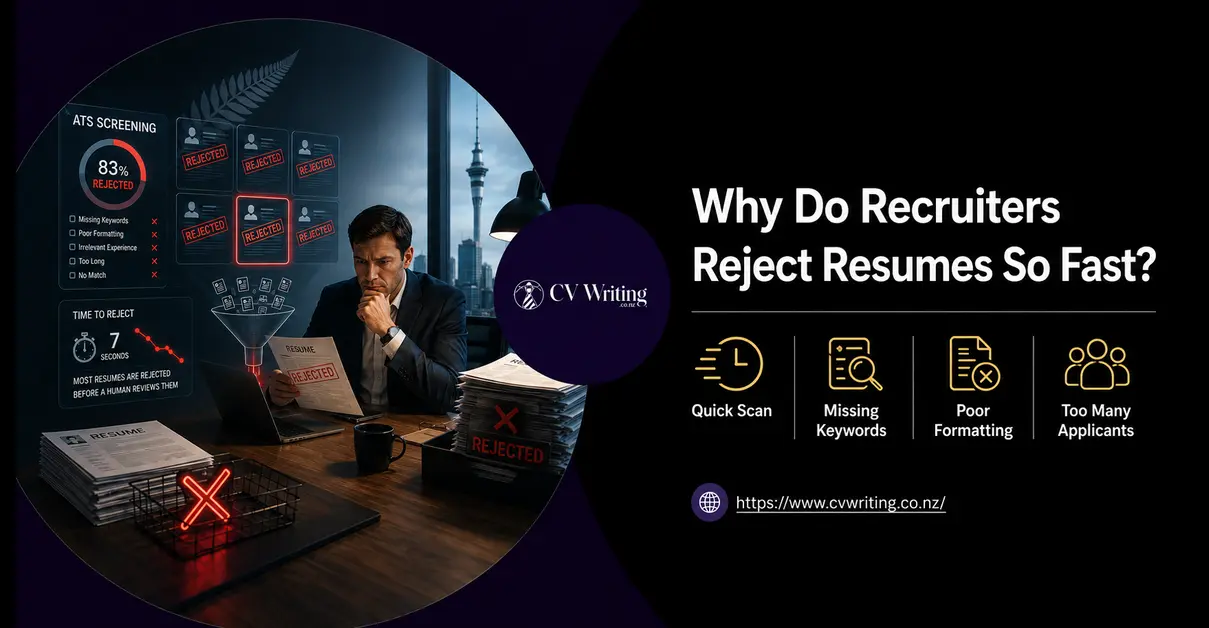
Why Do Recruiters Reject Resumes So Fast?
Why does the recruiter dismiss a resume right away? The recruiter’s main task is to discard the pile. It does not mean they are evaluating your entire career history within seconds. They just decide if your application is worthy of a more thorough review.
Your application needs to get through five gates: eligibility, relevance, evidence, confidence, and competition. If your application fails at any gate, it will not go on to the following stage.
It makes a big difference in how you can optimise your resume. Adding another template is useless if you lack a qualification. Inserting more keywords will not strengthen poor examples. Identify the gate that prevents you from getting there. Then address the issue.
What Five Gates Are Between You and an Interview?
The initial scan does not make a final decision. It answers one simple question: is the application worth a deeper review?
If the recruiter’s response is positive, he/she reviews the application carefully and matches your background to the vacancy. Every gate poses a certain question. Your answer should be obvious. Recruiters will not credit you for a skill you lack or have described poorly.
Here is the usual journey from application to shortlist:
| Gate | What the Recruiter Asks | What Gets You Through | What Stops You |
| Eligibility | Can this person apply? | The right qualifications, permission, location, and availability | A missing or unclear requirement |
| Relevance | Does their background fit? | Related work, skills, and recent experience | A general resume with no clear direction |
| Evidence | Can they prove their claims? | Real examples, responsibility, and results | Duties and personal qualities without proof |
| Confidence | Does the application make sense? | Matching dates, titles, and career plans | Gaps, mixed details, and unanswered questions |
| Competition | Are they among the strongest applicants? | A closer match than other candidates | Stronger competition or things you cannot control |

Our writers can review your CV, find the gate that is holding you back, and fix it for you.
Review My ResumeEligibility at Gate One
Gate One looks at the factors the employer just can’t ignore. These include having a degree, a professional license, a specific qualification, certain language skills, work authorisation, a required location, or a minimum number of years of specialist experience.
Here, you might not even be considered based on your experience. One answer regarding salary, location, availability, or work authorisation may disqualify you before anything else. Take time to read the screening questions. Never select a choice that you know isn’t true just to sound better.
Resume writing services can’t magically make you eligible for the position if you aren’t. Any honest help will let you know that. While they can make your qualifications stand out, they shouldn’t conceal anything that isn’t there.
Why Gate Two Can See That You’re Qualified
Sometimes it’s just a matter of making the match obvious. A variety of terms are used for the same positions. An “operations coordinator” does most of the tasks of an office manager. The recruiter might not know what the previous job was.
How Can You Get This Point Across?
- Use your actual job title, but describe your duties in terms people will recognise. If the advert calls for scheduling, procurement, or handling complaints, then demonstrate that you had the relevant experience.
- Do not assume that the recruitment agent is aware of any title that applied in your former organisation only.
- Effective CV writing leaves out the old stuff to give more room to the new.
- The relevant recent position should be explained in more detail than an irrelevant job from ten years back.
- Not everything has to be on your resume. Try keeping only relevant information; the rest can go into your CV.
Does Gate Three Bring Proof or Just Claims?
This is the gate that screens out many promising candidates. Their resumes describe them as organised, reliable, creative, hard-working, and skilled at communication. These are good-sounding adjectives, but practically everyone could use them. And you will have to back them up with some facts.
There is a simple recipe for doing so. Try action + scale + impact. “Managed bookings” is just the action part.
“Managed daily bookings for three consultants and introduced reminders that reduced missed appointments.”
Every achievement does not need to be presented as a percentage. You can describe the size of your team, number of clients, hard deadline, challenge you had to overcome, or additional responsibility. A little, truthful detail will be more valuable than big claims that you cannot substantiate during the interview.

What Will Help Pass Gates Four and Five?
The recruiter has already spotted your valuable experience by Gate Four. The only thing left to check is if your application is coherent. There may be a conflict in dates. There may be a mismatch between your LinkedIn title and your resume.
Maybe you are applying for an entirely lower position, and there is no reason stated.
Which Questions Should You Answer Early?
Only explain things that may affect the decision. If you are relocating, say where and when. If you are changing careers, connect your old skills with the new role. A professional cover letter writer can help, but the answer should remain short, clear, and true.
Gate Five is different. You cannot control all of it. You may meet every requirement and still lose to someone with more direct experience. There may be an internal applicant, a referral, a lower salary expectation, or a shortlist that was already taking shape.
How Can You Find the Gate That Keeps Closing?
You do not need to redesign your resume based on one refusal. Make a comparison of your ten resumes for similar positions. The quick refusal is a sign of Gate One, while the silence from relevant positions is a sign of Gate Two.
If you get calls for interviews, then your resume works. If recruiters offer you something irrelevant, your positioning is confused. LinkedIn profile makeover services can help you clarify your positioning without falsification of your work history.
Dos and Don’ts You Should Always Keep in Mind
| What Keeps Happening? | Likely Gate | Do | Don’t |
| Rejection arrives within minutes | Gate 1 | Check your answers and the firm requirements | Redesign the whole resume |
| Suitable roles produce no replies | Gate 2 | Move matching experience towards the top | Add skills you do not have |
| Recruiters look but do not call | Gate 3 | Replace claims with clear examples | Add more flattering words |
| Questions arise about dates or changes | Gate 4 | Give a short, honest explanation | Write a long personal story |
| You get some interviews but miss others | Gate 5 | Track more results before making changes | Blame every rejection on the resume |
| You interview often but receive no offers | Resume passed | Work on your interview answers | Keep changing a working resume |
Read Related Articles :
What to Include Or Not to Include in a Resume
Best CV Format for New Zealand
Frequently Asked Questions
Are applicant tracking systems used to automatically discard resumes?
Sometimes not. Many systems merely collect, organise or search CVs, while the decision to hire is left to recruiters. Use clear headings and appropriate language, but do not fill up the page with keywords or hidden text.
Is it true that all resumes should contain only two pages?
For many candidates, two pages work fine; however, relevance should matter rather than strict limitations. Experienced or technical people can have more content. Listen to the advert, omit irrelevant information, and provide your best arguments at the top.
Does a fast refusal indicate a bad resume?
This is not always so. Competition, time, salary, location, the application from within or missing requirements can lead to a rejection. Consider several examples of similar job seekers and look for problems.
Key Takeaway
A recruiter is not rejecting everything you can offer in a few seconds. Your application has simply reached a gate and failed to give the answer needed to move forward. Finding that gate gives you something useful to fix.
Check eligibility first. Make the match easy to see. Back up your claims with real examples. Clear up any details that may create doubt. And remember that competition still matters. When every gate has a clear answer, the recruiter has a good reason to keep reading.
Ready to Get Through Every Gate?
Our writers know what recruiters look for at each stage of the process. Let’s build a CV that gets through every one.
Get Started TodayYour CV keeps getting rejected. Let a professional fix it.
Hire a CV Writer
Mila Jones is a professional CV writer at CV writing NZ, she knows exactly what it takes to catch a recruiter’s eye. Mila specializes in crafting modern resumes and writing insightful blogs that cover everything from cover letter trends to interview-winning strategies. Her expert tips are a go-to resource for anyone looking to increase their interview calls and secure better job offers.